The Privileged Planet Documentary
About the Documentary
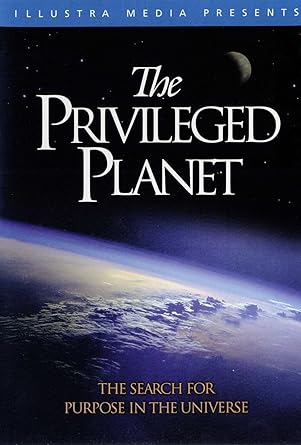
Many scientists and philosophers have claimed that Earth is an ordinary speck of dust adrift, without purpose or significance, in a vast cosmic sea. Yet current astronomical evidence seems to suggest just the opposite.
We now know that a rare and finely-tuned array of factors makes Earth suitable for complex life. We depend on our planet’s oxygen-rich atmosphere, its large moon, its planetary neighbors, and its precise location within the solar system and Milky Way galaxy. But there is more. The same factors that make a planet like Earth hospitable to life also provide the best conditions for scientific discovery.
Is this correlation merely a coincidence? Or does it point to a deeper truth about purpose and intelligent design within the cosmos?
The Privileged Planet is based on the book with the same title by Jay Richards and Guillermo Gonzalez. Production began in October 2002 and was completed in June 2004. The documentary presents the Richards/Gonzalez hypothesis that the Earth was designed to both sustain complex life and enable scientific discovery.
Location photography took place at the Mt. Wilson Observatory, the University of Washington, Jet Propulsion Laboratory, Iowa State University, the Parkes Observatory, and other locations in the United States and Australia.
The film is highlighted by interviews with leading astronomers and cosmologists including Robert Jastrow (author of God and the Astronomers), Paul Davies (The Mind of God, Accidental Universe, The Big Questions), and Donald Brownlee (Rare Earth).
The Privileged Planet includes extensive computer animation that illustrates the structure and operation of the Milky Way galaxy, black holes, solar eclipses, planetary magnetic fields, and our own solar system. A highlight of the documentary is a journey from Earth to the edge of the known universe.
In June 2005, the Discovery Institute arranged for a special showing of the film at the Smithsonian Institute. The event triggered a firestorm of controversy and media coverage in response to what many perceived as the Smithsonian’s endorsement of the theory of intelligent design. The Smithsonian ultimately withdrew its initial support of the screening which took place as originally scheduled. The Privileged Planet was also aired on PBS during 2005-06.
The film has been translated into several languages including German, Mandarin, Cantonese, Romanian, Japanese, and Czechoslovakian.
In addition to the 60-minute feature documentary, the English DVD version includes almost an hour of bonus features.
Scientists and Scholars
The Privileged Planet documentary includes interviews with scientists and scholars who have studied the origin and physical characteristics of the universe and the Earth. Here you will find more information about the experts featured in the film.
Guillermo Gonzalez
Senior Fellow, Center for Science and CultureJay W. Richards
Senior Fellow at Discovery, VP of Social and Domestic Policy at Heritage FoundationRobin Collins
Robin Collins is a Professor of Philosophy at Messiah College. He received his Ph. D. in Philosophy from the University of Notre Dame under Alvin Plantinga. His undergraduate work was done at Washington State University where he studied philosophy, physics and applied mathematics. He has been interviewed for several documentaries and is currently writing a book on the anthropic principal — the idea that the universe is finely-tuned to sustain life.
Seth Shostak
Seth Shostak is a senior astronomer at the SETI Institute. He received his Ph.D. from the California Institute of Technology after having received his undergraduate degree in physics at Princeton. He is a leading figure in the search for extraterrestrial intelligence. Shostak hosts the radio program Are We Alone? He also hosts Skeptic Check, a radio program aimed at exposing pseudo-sciences such as astrology. In 2004, Shostak was awarded the Klumpke-Roberts Award for his “contribution to the public understanding and appreciation of astronomy.”
Robert Jastrow
Robert Jastrow (1925-2008) was an American astronomer and physicist. He completed both his undergraduate and graduate work at Columbia University, receiving his Ph.D. in theoretical physics in 1948. Jastrow joined NASA when it was founded and was the first chairman of NASA’s Lunar Exploration Committee, a group established to determine the exploratory objectives for the Apollo moon landing crew. He was also Chief of the Theoretical Division at NASA. Dr. Jastrow went on to become a Professor of Earth Sciences at Dartmouth College, the founder of the George C. Marshall Institute, and Director Emeritus of Mt. Wilson Observatory. He authored the best-selling book, God and the Astronomers.
Bijan Nemati
Chief Scientist and Founder, Tellus1 ScientificDonald Brownlee
Donald Brownlee is Professor of Astronomy at the University of Washington, where he received his doctorate in Astronomy. Brownlee’s research interests include investigations of interplanetary dust, comets, meteorites, and the origin of the solar system. He also conducted research as a Distinguished Visiting Professor at the Enrico Fermi Institute (University of Chicago). Asteroid 3259 Brownlee was named for him in 1991. Brownlee has received numerous awards and honors, including the J. Lawrence Smith Medal from the National Academy of Sciences, the Leonard Medal from the Meteoritical Society, and the NASA Medal for Exceptional Scientific Achievement. He was elected a Fellow of both the Meteoritical Society and the American Association for the Advancement of Science. Brownlee is the Associate Editor of Meteoritics and is on the Editorial Advisory Board of Microbeam Analysis Journal. He is currently a principal investigator for the STARDUST Discovery mission, that collected comet samples and returned them to Earth.
Charles Beichman
Charles Beichman is Executive Director of Michelson Science Center, NASA’s premier institution for the search for planets and life beyond the solar system. He leads a team of researchers who will use the Space Interferometer Mission (SIM) to find planets orbiting newly formed stars and is the project scientist for the Terrestrial Planet Finder mission. As Director of the Infrared Processing and Analysis Center (IPAC, 1991-1998) he worked on the IRAS and ISO missions and led the software development for the 2 Micron All Sky Survey. As Chief Scientist for Astronomy and Physics at the Jet Propulsion Laboratory, he helped to develop NASA’s Origins program, the goal of which is the search for planets beyond our solar system. Beichman received his undergraduate degree in Astronomy from Harvard in 1973 and his graduate degrees in Physics and Astronomy in 1979.
Kevin Grazier
Kevin Grazier is a planetary scientist with NASA’s Jet Propulsion Lab, specializing in large scale computational simulations of the solar system. He earned a B.S. in Geology and Computer Science from Purdue University and later added a B.S. in Physics from Oakland University. He also earned an M.S. in Physics from Purdue before earning his doctorate from UCLA. Upon arriving at the JPL, Grazier wrote a piece of multi-mission planning and analysis software which earned him numerous awards from both JPL and NASA. Grazier continues to work with JPL and is part of the Cassini Mission team. He also gives planetarium presentations at LA’s Griffith Observatory and has served as the scientific advisor for several SyFy channel shows including Eureka and Battlestar Gallactica.
Paul Davies
Paul Davies is a British-born theoretical physicist, cosmologist, astrobiologist, and best-selling author. He is Director of the Beyond Center for Fundamental Concepts in Science and co-Director of the Cosmology Initiative — both at Arizona State University. He received his BSc from University College London in Physics and went on to obtain his PhD in theoretical physics (also from UCL). Davies’s primary contributions have been in the area of quantum physics, specifically the Fulling-Davies-Unruh effect and the Bunch-Davies vacuum state. He has been awarded numerous times for his proficiency in teaching science, having received the Faraday Prize in 2002, a Kelvin Medal, two Eureka Prizes and an Advance Australia Award. He is also a prolific writer, having written over twenty-five books as well as countless articles for The Guardian, The New Scientist, The New York Times, The Age and many others.
Resources
The Privileged Planet: The Search for Purpose in the Universe examines some of the most fundamental questions in astronomy and cosmology: Is life common or rare in the universe? Is the existence of a habitable planet like Earth the result of cosmic purpose or merely good luck? What does it take to build a habitable planet? What makes scientific discovery possible?
While exploring these questions, the documentary describes the intriguing argument made by Guillermo Gonzalez and Jay Richards in their book, The Privileged Planet, that the rare conditions that produce a habitable planet also provide the best overall setting for scientific discovery.
Narrated by actor John Rhys-Davies and featuring a diverse group of scientists and experts, The Privileged Planet documentary casts new light on the perennial question: What is our place in the universe?
To learn more about the evidence, ideas, and people, discussed in The Privileged Planet documentary, explore the resources below.
Books
Guillermo Gonzalez and Jay Richards, The Privileged Planet: How Our Place in the Cosmos is Designed for Discovery (Washington DC: Regnery, 2004)
D. Scott Birney, Guillermo Gonzalez and David Oesper, Observational Astronomy (Cambridge: Cambridge University Press, 2006).
Peter Ward and Donald Brownlee, Rare Earth: Why Complex Life is Uncommon in the Universe (New York: Springer, 2003).
General Articles
Jay Richards and Guillermo Gonzalez, Are We Alone in the Universe? American Spectator (May 1, 2004)
Jay Richards, The Search for Extraterrestrial Life: The Question That Won’t Go Away, The Colson Center (May 19, 2010)
Guillermo Gonzalez and Jay Richards, Paleomagnetism and The Privileged Planet, Discovery Institute (Oct 5, 2004).
Guillermo Gonzalez and Jay Richards, A Response to Some Objections by Kyler Kuehn to The Privileged Planet, Discovery Institute (April 29, 2004).
Guillermo Gonzalez and Jay Richards, Was Starlight Deflection Important for the Acceptance of General Relativity?, Discovery Institute (August 2, 2004).
Guillermo Gonzalez, Donald Brownlee, and Peter Ward, Refuges for Life in a Hostile Universe, Scientific American (Oct. 2001).
Guillermo Gonzalez and Jay Richards, Priest of the Cosmos, Touchstone (Nov. 2006).
For a discussion and study guide of The Privileged Planet documentary, see The Privileged Planet Discussion and Study Guide, by Ryan Huxley of the IDEA Center.
Some Related Scientific Papers
Guillermo Gonzalez, Habitable Zones in the Universe, Origins of Life & Evolution of Biospheres Vol. 35, no. 6 (Dec. 2005)
Guillermo Gonzalez, Mutual Eclipses in the Solar System, Astronomy & Geophysics Vol. 50, no. 2 (April 2009)
Guillermo Gonzalez, The Galactic Habitable Zone, in Proceedings of the Space Telescope Science Institute Symposium (2005).
Guillermo Gonzalez, Donald Brownleee, and Peter Ward, The Galactic Habitable Zone: Galactic Chemical Evolution, Icarus Vol. 152, no. 1 (2001).
Llyd Wells, John C. Armstrong, and Guillermo Gonzalez, Reseeding of early earth by impacts of returning ejecta during the late heavy bombardment, Icarus Vol. 162, no. 1 (March 2003).
Llyd Wells, John C. Armstrong, and Guillermo Gonzalez, Rummaging through Earth’s Attic for Remains of Ancient Life, Icarus Vol. 160, no. 1 (Nov. 2002).
Guillermo Gonzalez, Is the Sun Anomalous? Astronomy & Geophysics Vol. 40, no 5 (Oct. 1999).
Guillermo Gonzalez, Wonderful Eclipses, Astronomy & Geophysics Vol. 40, no. 3 (June 1999).
Stories and Reviews
David Hughes, Review of The Privileged Planet, The Observatory Vol. 125, no. 1185 (April 2005).
Mike Martin, Are We Alone in the Universe? Hispanic Magazine (Nov. 22, 2004).
Amy Combs, Review of The Privileged Planet, Astronomy (December 1, 2004).
Philip Gold, The Universe: A Lab Designed with Us in Mind? The Washington Times (April 18, 2004)
Production Credits
Executive Producers
James W. Adams
Larry Frenzel
Producer/ Director
Lad Allen
Written by
W. Peter Allen
Jonathan Witt
Edited by
Jerry Harned
Photography by
Matthew Valentine
Jerry Harned
Dennis Burkhart
Original Music by
Mark Edward Lewis
Computer Animation
Tim Doherty
Jerry Harned
Narrated by
John Rhys-Davies
International Versions
The Privileged Planet continues to be translated and distributed throughout the world. Completed international versions include:
- Bulgarian
- Cantonese
- Czechoslovakian
- German
- Indonesian
- Japanese
- Mandarin
- Romanian
- Slovakian
For more information regarding international translation licenses contact: illustramedia.com/international/